Retirement Risk: The Final Bill for America's First Wind Fleet
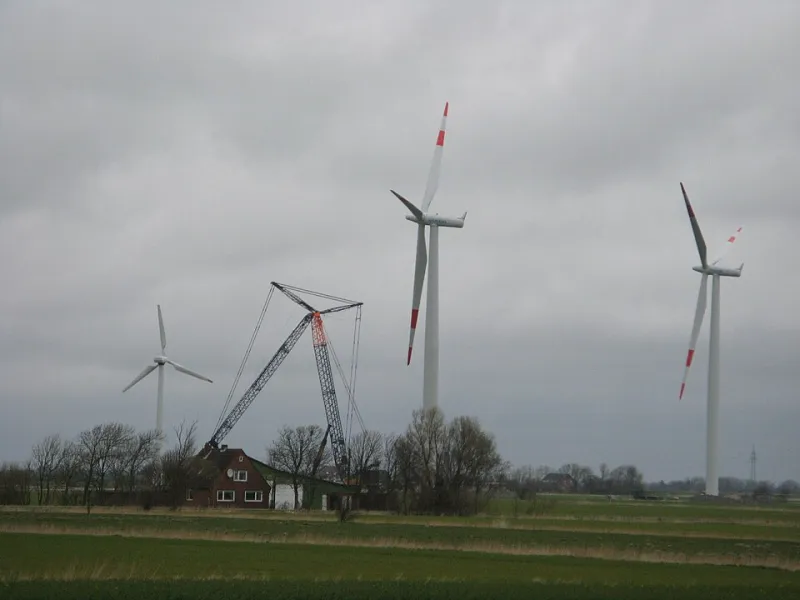
Photo: wind turbine decommissioning blade removal, via www.esa.int
America's first utility-scale wind farms are no longer a novelty story. They are an aging asset class. Projects built in the late 1990s and early 2000s are reaching the end of their original design lives, and in 2026 the question is no longer whether they will be decommissioned but who will pay for the work. For years, decommissioning obligations lived in footnotes and county filings. Now they are showing up in credit reviews, purchase-price adjustments, and bankruptcy court.
From Footnote to Forecast
The shift is structural. A wind farm is a bundle of leases, permits, power purchase agreements, and physical assets. Decommissioning is a future cash outflow that must be estimated, funded, and monitored. Owners must remove towers, blades, foundations, roads, and substations to the depths and grades specified in leases and county agreements. Costs vary by terrain, turbine size, disposal routes, and local labor, but they are rarely trivial. Salvage credits for steel and copper can offset part of the expense; they do not eliminate it. As fleets age, estimates tend to rise because disposal rules tighten and construction labor becomes more expensive.
The Bonding Patchwork
There is no single national decommissioning standard for wind. State public utility commissions, county boards, and federal land managers each impose different requirements. Iowa, Minnesota, Texas, and Oregon have distinct approaches to financial assurance. County agreements often require a decommissioning plan, a financial assurance instrument, and a timetable. Instruments include surety bonds, letters of credit, cash escrow, and parent guarantees.
The weakness is that many arrangements were negotiated when projects were new and expected to be repowered. Bond amounts may rest on stale cost estimates. Some counties lack the staff to review them. On federal land, Bureau of Land Management bonds add another layer but do not cover private leases. For asset managers, the lesson is that a bonding requirement is not the same as a funded obligation. The credit quality of the entity behind the bond matters as much as the face amount.
Bankruptcy and the Orphaned Turbine
The most severe risk is insolvency. If a project owner files Chapter 11, decommissioning obligations compete with secured debt and other claims. A bankruptcy sale can transfer assets free and clear, leaving counties and landowners to pursue limited claims. In practice, the financial assurance may be the only dedicated pool of money. If the bond is undersized or expires, the public can inherit the problem.
That is why lenders and county attorneys are paying closer attention to the identity of the obligor. A parent guarantee from a creditworthy sponsor is stronger than a bond from a thinly capitalized project company. A cash escrow is stronger still, though it ties up capital. In 2026, some counties are demanding periodic reassessments of decommissioning cost rather than a one-time estimate at permitting.
Negotiating the Legacy Liability
In asset deals, decommissioning is a bargaining chip. Sellers want to transfer the obligation with the asset; buyers want a discount, escrow, or indemnity. Transactions are increasingly structured with a decommissioning reserve funded at closing, a purchase-price holdback, or a letter of credit that steps down over time.
Repowering complicates the math. A new turbine reset can extend the asset life but also changes the eventual removal cost. Buyers are scrubbing county agreements, lease exhibits, and historical bond filings. Some are using independent cost estimators rather than relying on the seller's numbers. The most sophisticated buyers are also reviewing whether the seller has kept pace with changing disposal rules for blades and composite materials.
A Balance-Sheet Discipline
For asset managers, the practical response is to treat decommissioning as a live liability. That means annual cost reviews, credit support monitoring, and clear ownership of the obligation inside the organization. It also means engaging counties early. A well-funded, transparent plan is cheaper than a contested bankruptcy.
The wind fleet's first retirement wave will not be the last. The companies that price it now, disclose it clearly, and fund it credibly will be better positioned when the next generation of assets reaches the end of the line.