The Bill Comes Due: Five States Where Electricity Costs Turned Into a 2025 Political Battleground
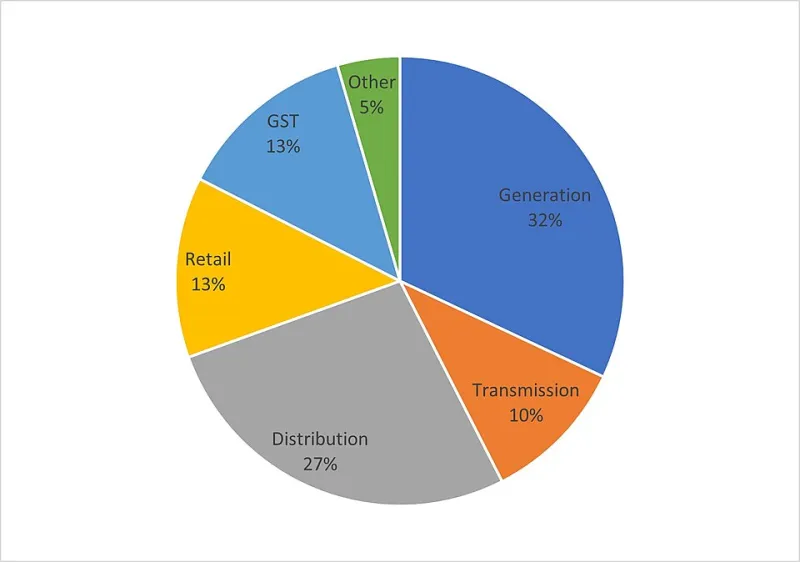
Photo: Marshelec, CC BY-SA 4.0, via Wikimedia Commons
Energy policy debates used to live in technical dockets and industry conferences. No longer. In 2025, the monthly electric bill has become a headline issue in gubernatorial races, legislative sessions, and — increasingly — congressional campaigns. The pattern is national, but its intensity varies sharply by state. Here are five where the friction is highest, and why.
1. California: The Wildfire Surcharge
California's rates, already among the highest in the nation, have absorbed the cost of catastrophic wildfire liability, undergrounding programs, and an aggressive clean energy build. The introduction of income-based rate structures — intended to shield low-income households — has instead generated its own political backlash from middle-class customers who see their bills rise. With utilities proposing further increases to fund grid hardening, the question of who pays for climate adaptation has rarely been more contested.
2. Texas: Growth Outpacing the Grid
Texas prides itself on cheap power, and that self-image is now under strain. Explosive demand from data centers and industrial electrification, combined with the February 2021 freeze still fresh in public memory, has driven massive investment in transmission and firm capacity. The state's energy-only market design means much of that cost flows to customers through ancillary charges that most residents only discover when the bill arrives. Lawmakers have responded with bills to make large industrial users pay more of their own infrastructure costs — a fight that will define the next legislative session.
3. Arizona: The Data Center Dividend Question
Arizona's rapid data center build-out has delivered jobs and tax revenue, but regulators and ratepayer advocates increasingly ask whether residential customers are subsidizing the enormous infrastructure serving hyperscale buyers. The state commission's proceedings on large-load rate classes have become a genuine political contest, with consumer groups, utilities, and the technology sector all lobbying hard.
4. Maine and New England: The Natural Gas Trap
New England's dependence on natural gas — and its constrained pipeline capacity — leaves the region exposed to global price spikes every winter. Rate shock events in recent years put the region's bills among the nation's highest, and proposals for new transmission, offshore wind contracts, and Canadian hydro imports all carry price tags that become political ammunition. Every cold snap reopens the argument.
5. Georgia: The Vogtle Hangover
Georgia Power's customers are now paying the full freight of the Vogtle nuclear expansion through rate cases that have stacked increases on top of one another. The utility argues the plants will deliver value for decades; consumer advocates counter that shareholders captured the upside while ratepayers absorbed the overruns. The state legislature's periodic reviews of the regulatory compact have taken on new urgency.
The Distribution Question Nobody Can Dodge
Strip away the local details, and every one of these fights is the same fight. America's grid needs hundreds of billions in investment — for wildfire hardening, load growth, aging infrastructure, and decarbonization. That money must come from somewhere, and the candidates are three:
Utilities and shareholders bear some responsibility for decades of underinvestment and, in wildfire cases, outright negligence. Socializing those costs onto customers is a transfer, not a necessity.
Regulators face a genuine dilemma: pressing costs onto utility investors raises the cost of capital and can slow the very investment reliability requires. But rubber-stamping rate cases invites abuse.
Ratepayers are the residual claimant by default — and increasingly, the ones organizing. Large industrial and data center customers, who drive disproportionate infrastructure costs, are the most defensible place to assign a larger share. Targeted rate classes for hyperscale load, shareholder-funded hardening mandates, and honest accounting of legacy costs would go further than blanket subsidies or blanket blame.
The transition will be expensive no matter who pays. The political question of 2025 is not whether the bill comes due — it is whose name is on it.