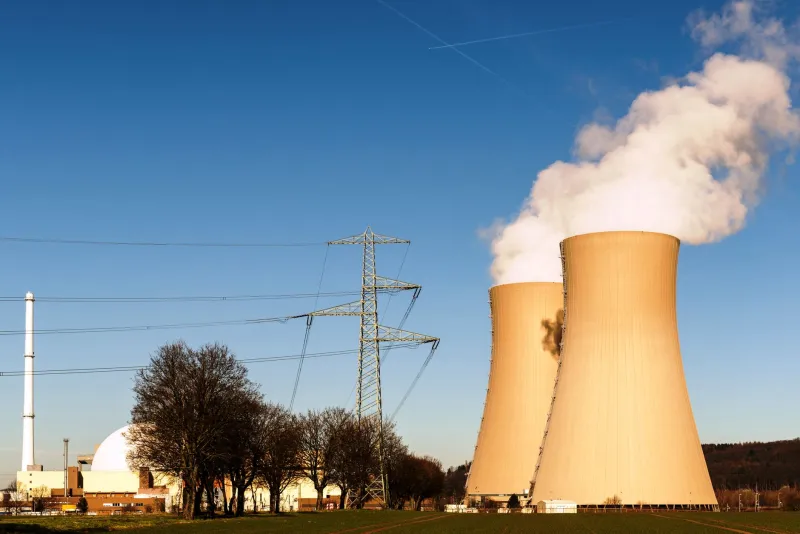
The Value Hiding in Plain Sight: Utilities Repurchasing Their Own Depreciated Assets
Photo: Trougnouf, CC BY 4.0, via Wikimedia Commons
The prevailing script in the energy sector says that legacy thermal generation is a liability to be managed down: retire it, divest it, write it down, and redeploy capital toward renewables and grid investment. Most boards have internalized this narrative so thoroughly that questioning it feels almost heretical. Yet a handful of utilities and independent operators are pursuing a counterintuitive strategy—repurchasing or retaining depreciated generation assets at or near book value—and the more closely one examines the economics, the more defensible it looks.
This is not nostalgia for the fossil era. It is an arbitrage, and it is one that most investors and, frankly, most boards have failed to price.
The Book Value Illusion
Start with the accounting. A gas or coal plant that has been depreciated over three or four decades may carry a book value that bears almost no relationship to what it would cost to replace. The market's obsession with replacement cost is usually discussed in the context of new build—turbine lead times, EPC inflation, interconnection delays—but the same logic applies in reverse. If a comparable new facility would cost several multiples of the existing asset's carrying value, then an existing asset generating dependable capacity revenue is, on any rational replacement basis, undervalued on the balance sheet.
When such an asset trades—or when a utility buys back a minority stake it previously sold—at a discount to depreciated book, the acquirer is effectively purchasing replacement capacity for pennies on the dollar of new-build cost. In a market where capacity prices in several regional transmission organizations have risen sharply, the cash yield on that purchase price can be extraordinary.
Reliability Attributes Are Underpriced
The second leg of the argument is the reliability premium. The American grid is entering a period of acute resource adequacy stress. Data center load growth, electrification, and the retirement of baseload capacity have tightened supply-demand balances across PJM, ERCOT, and elsewhere. Capacity market clearing prices have responded accordingly, and regulators in state after state are signaling that dispatchable resources will be compensated for the reliability attributes they provide.
Yet the market's valuation of legacy thermal assets frequently embeds a terminal decline assumption that ignores this repricing. A plant that can run reliably for another fifteen years, backed by fuel security and established interconnection rights, is not a stranded asset in the way the standard narrative assumes. Its optionality—particularly its ability to serve load during extreme weather events, when scarcity pricing and political tolerance both spike—is worth something the market has not yet capitalized.
Why Boards Overlook It
The reasons this arbitrage persists are behavioral as much as analytical. ESG screens discourage many institutional investors from holding thermal generation regardless of price, which suppresses the buyer universe and keeps discounts wide. Corporate strategy groups, eager to present transition narratives, book write-downs that signal virtue but may destroy real economic value. And the transaction costs and headline risk of repurchasing a 'yesterday's technology' asset deter managements even when the spreadsheet says otherwise.
There is also a genuine risk on the other side of the ledger, and honest analysis requires acknowledging it. Regulatory exposure, carbon policy trajectories, and the possibility that capacity market reforms favor storage over thermal all threaten the thesis. A plant's remaining useful life is a regulatory judgment as much as an engineering one.
The Case for a Second Look
But the burden of proof should run in both directions. Boards that reflexively approve divestiture of depreciated dispatchable assets at distressed multiples are making an implicit forecast—that reliability will not be scarce, that replacement capacity will be cheap and quick to build, and that capacity prices will not sustain. Each of those assumptions is increasingly questionable.
The utilities quietly acting on this logic—retaining assets rather than selling, repurchasing interests at book, investing in life-extension rather than retirement—are not fighting the transition. They are pricing it. And in a sector where the consensus has a way of overcorrecting, the least fashionable trade on the boardroom agenda may also be the best one available.