Who Answers When the Algorithm Balances the Grid? The Accountability Question Utilities Can No Longer Postpone
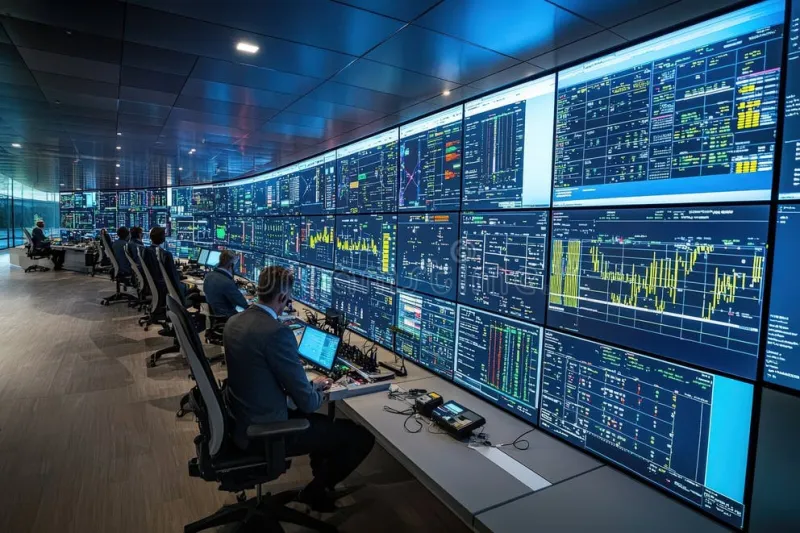
Photo: utility grid control room operators large screens monitoring electricity, via thumbs.dreamstime.com
Somewhere in a control room in the American heartland, a software recommendation is about to become a dispatch instruction. The operator on shift will approve it, almost certainly. But the margin between human judgment and machine execution is narrowing with every deployment of AI-assisted dispatch, and the industry's answer to a deceptively simple question — who is accountable when the algorithm runs the grid? — remains unresolved.
The Case for Reluctance Is Not Luddite
Grid operators are often caricatured as resistant to change. Their skepticism deserves more credit than it usually receives. Control room professionals have spent careers internalizing the difference between a model that looks right on a screen and a system that behaves correctly when a transmission line trips during a heat event. Reliability, in their world, is measured in decades of avoided catastrophe — and the cost of a bad autonomous decision is not a lost quarter; it is a blackout.
There is also a legal vacuum. Federal Energy Regulatory Commission rules, NERC reliability standards, and state public utility codes were all drafted assuming a human made every balancing decision. When an AI system curtails a resource or clears a market in a way that causes harm, the chain of liability — developer, utility, system operator, regulator — has no settled answer. That ambiguity is not an academic concern; it is a barrier to deployment, because no general counsel will sign off on an unassigned risk.
The Case for Moving Anyway
Yet the argument for hesitation weakens with every passing season. Distributed solar, batteries, electric vehicles, and bidirectional load are multiplying the decision variables on the grid faster than human operators can process them. California's duck curve, Texas's weather-sensitive demand swings, and the sheer count of behind-the-meter resources make traditional manual balancing increasingly untenable. The complexity is not waiting for governance to catch up.
Several regional operators and large utilities are already running AI systems in shadow mode — observing, recommending, learning — while humans retain final authority. That is a sensible interim architecture. It is not a permanent one.
A Framework Worth Deciding On
The sector would benefit from three commitments made now, before an incident forces them. First, clear accountability mapping: a named human or entity responsible for every class of autonomous action, codified in reliability standards rather than vendor contracts. Second, explainability requirements proportionate to consequence — a model steering a balancing market should be far more auditable than one forecasting next week's load. Third, staged autonomy with explicit rollback authority, so operators can pull systems back to human control without ambiguity.
The Verdict
The question is not whether AI will dispatch the grid. Given the resource complexity now arriving, it almost certainly will. The question is whether the industry defines accountability on its own terms, deliberately, or has it defined for it — by a regulator reacting to a failure, or a courtroom after one. Utilities, system operators, and standards bodies should treat that choice as urgent. The wires are already listening for an answer.